
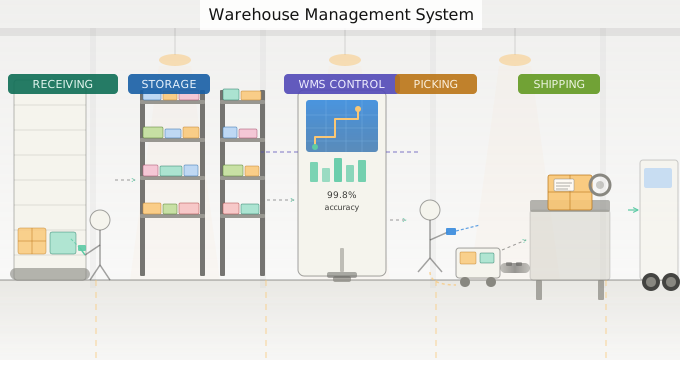
In the last few years, the logistics landscape has changed dramatically. Explosive e-commerce growth, rising customer expectations, and a growing shortage of skilled warehouse labor have pushed fulfillment operations to their limits. At the center of this shift is the Warehouse Management System (WMS), once a simple inventory tracking tool, now the backbone of modern warehouse operations.
A well-implemented WMS can transform your fulfillment center from constant chaos into complete operational control. So, what exactly is a Warehouse Management System and how does it work? Let’s break it down in plain English.
What is a Warehouse Management System (WMS)?
A Warehouse Management System is a software platform that helps businesses manage, track, and optimize warehouse operations in real time, from the moment a truck backs up to your dock to the second an order goes out the door to a customer.
Instead of relying on spreadsheets, paper logs, or institutional memory, a WMS acts as a centralized operating system for your warehouse. It provides real time visibility into inventory levels, product locations, order status, and labor activity, allowing teams to work faster, more accurately, and with far fewer errors.
Is Your Warehouse Working for You or Against You?
Think about your warehouse.
- Is your team constantly searching for misplaced inventory?
- Do stockouts or surprise shortages catch you off guard?
- Are picking errors driving up returns and customer complaints?
If you are still running an analog warehouse, your daily operations become a balancing act. Staff are pulled off productive work to do cycle counts, pickers walk unnecessary miles across the warehouse floor, and your customer service and receiving teams find their days dominated by returns caused by mis-picks and shipping errors.
Mistakes happen, sure. But when the average cost of a single picking error is over $22, mistakes add up very fast.
When productivity, accuracy, and efficiency feel like a constant struggle, the problem usually isn’t your people, it is your systems.
How Does a Warehouse Management System Work?
To understand how a WMS works, let’s follow a single product through a WMS-powered fulfillment center, because every touch point within your facility represents opportunities for efficiency gain and error reduction.
Smarter Receiving with a WMS
Everything starts at the dock.
Before a truck even arrives, your WMS already knows what is on it. Through advanced scheduling and dock assignment, shipments are planned in advance, preventing congestion, labor bottlenecks, and unloading delays.
As the inventory is unloaded, workers use barcode scanners to check items against the purchase order, allowing them not only to ensure they are receiving the proper shipment but also to instantly log each item into your inventory.
Once received, the WMS continues to play a crucial role, communicating to your workers exactly where to store the item for future efficiency.
No matter the size of your facility, optimizing storage saves both time and money. Think about your kitchen at home. Like your warehouse, storage space is finite. If you started storing the coffee cups you use every morning behind the stand mixer you use once every six months, the frustration of lost time and unnecessary work would be felt instantly each time you had to dig behind the mixer to pull out a mug.
Your WMS functions as a digital brain that can analyze data and know the frequency items are picked, any seasonal demands, and can optimize the organization of your warehouse by grouping items frequently ordered together, the way you have optimized your kitchen by storing the knives and forks in the same drawer.
Faster Order Fulfillment
Order fulfillment is where a Warehouse Management System provides the highest return on investment.
When an order is placed, the WMS:
- Determines the most efficient pick path
- Groups orders intelligently
- Directs workers step-by-step through the warehouse
Pickers follow optimized routes that minimize unproductive walking (known as “deadheading”) while barcode scanners verify each item in real time while the system updates the inventory count in the background.
These smart features integrated into your warehouse operations result in faster picking, fewer errors, and dramatically improved throughput.
Accurate Packing and Shipping
At the picking station, the WMS performs a final accuracy check. Each item is scanned again to confirm it matches the order, reducing mis-picks from as high as 15% of orders down to less than 1%.
Modern WMS platforms also run a cartonization algorithm to calculate the optimal box or envelope size for each shipment. This reduces shipping costs by saving the amount of “expensive air” carriers charge for.
Finally, the system automatically generates shipping labels and required documentation, including customs forms for international orders. Customers can even receive automated shipping notifications the moment their order leaves the warehouse.
Benefits of Using a WMS
So, lets talk numbers, because the return on investment a warehouse management system brings is what has made it a no-brainer industry-leading warehouse operations across the globe. By harnessing a barcode scanning system at every movement in, out, and around the warehouse, a warehouse management system can push your inventory accuracy up to 99.8%.
With that level of accurate, real-time data, you are essentially eliminating the cost of stock outs, overstocking, and lost inventory write-offs. You know exactly what you have at all times. And that accuracy rate extends to orders too, saving your customer service department time fielding angry calls and emails along with all the money you save on returns.
But accuracy isn’t the only number impacting your ROI, industry data shows that modern WMS solutions can increase throughput by 50-200% while reducing picking times by 20-30%. In our modern world where customers have been trained on same and next day shipping, that level of speed can be a huge competitive advantage.
Labor costs go down, storage space is optimized, mistakes and returns stop unnecessarily inflating your expenses, but most importantly, your company builds a reputation for being reliable.
Is a WMS Right For My Business?
Ask yourself:
- Do you fully trust your data?
- Is your warehouse operating efficiently and effectively?
- Are customers getting exactly what they ordered, on time, every single time?
If those questions give you pause, it is time to explore how a Warehouse Management System can be tailored to support your specific operation.
A discovery call is often the fastest way to identify where inefficiencies are hiding, and what kind of WMS solution will deliver the greatest impact for your business.